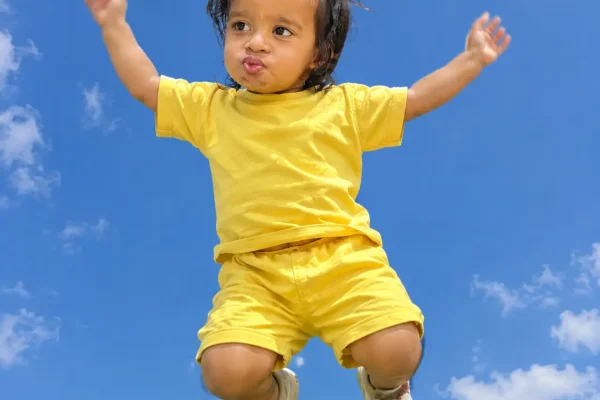
There's one kind of childhood photo that nobody ever regrets taking. A little kid shot from down low against a completely clear blue sky — mid-jump, arms flung out, hair lifting, looking about ten feet tall. It's the angle that makes a four-year-old look like they own the whole sky, and it's become one of the most-loved AI photo trends of the year.
The low angle blue sky AI photo prompt has been doing the rounds for a couple of months now, but almost every version you'll find was written for adults — confident poses, sunglasses, hands in pockets, dramatic ultra-wide lenses. Run one of those on your child's photo and the result comes out strange. The pose is wrong for a kid, the face gets distorted, and more often than not the sky turns into a pale white glare.
This page is written for children specifically. Below are four prompts built around what kids actually do outdoors, plus the lighting detail that decides whether you get a deep blue sky or a washed-out one.
Why Adult Low Angle Prompts Fail on Kids
Three differences, and each one shows up in almost every failed attempt.
"Low angle" means something different for a child. An adult's eye level is around five and a half feet, so a camera at waist height already looks up at them. A small child's eye level is barely three feet. Ask for a "camera slightly below eye level" and you get what is basically a normal shot. For the heroic look, the lens has to be practically on the grass, pointing up.
Ultra-wide lenses distort small faces badly. Adult prompts love 14mm and 24mm lenses for that dramatic stretched perspective. On a child's face — which is already rounder and softer — the same lens enlarges the chin and nostrils and shrinks the forehead. It looks odd and it stops looking like your kid. A moderate wide lens from a little further back gives the height without the distortion.
Adults pose. Kids move. Hands in pockets and a confident stare read as serious on an adult and stiff on a child. The version of this photo that works on kids is the one where they're in the middle of doing something — jumping, spinning, chasing, reaching.
Getting a Deep Blue Sky Instead of a White One
This is the single biggest reason these photos fail, and it has nothing to do with the prompt's length.
When the sun is behind the child, the sky around them is the brightest part of the scene. The camera can either expose for the sky, which turns the child into a dark silhouette, or expose for the child, which blows the sky out to pale white. Neither gives you that rich saturated blue.
Real photographers get the deep blue by keeping the sun behind or beside the camera, so the light falls on the child's face and the sky behind them is the darker, bluer part of the dome. The sky is naturally at its deepest blue away from the sun.
A Few Rules When the Photo Is of a Child
Lock the age every time. AI models drift toward older, slimmer faces unless told otherwise, and a low angle makes it worse. Every prompt above includes an explicit age instruction for that reason.
Never ask for makeup. Adult sky prompts often mention "glowing skin" or "flawless complexion". On a child, leave the skin exactly as it is.
Use a clear, unfiltered photo. Front-facing, good light, face clearly visible. A filtered photo hands the model altered features and the likeness rarely survives.
Think about where the photo goes. A public account with a child's face and details in the caption is more than most parents mean to share. Family groups and close-friends lists get the warmest reactions anyway.
When It Doesn't Come Out Right
The sky is pale or white. The sun is behind the child. Use the lighting line above — sun behind the camera, face lit, deep blue behind.
The child is a dark silhouette. Same cause. Move the light source.
The face looks stretched or odd. You used an ultra-wide lens. Switch to 35mm and step the camera back.
It doesn't look low angle at all. Your prompt said "slightly below eye level". For a child, specify the camera at ground level pointing up.
The face looks older. Add keep the child's exact age and facial proportions, do not mature the features.
The pose looks stiff. Give the child something to do. Movement beats posing every time.
FAQ
Do these prompts work on the free version? Yes, on both ChatGPT and Gemini, with daily generation limits.
Which tool keeps a child's face better? Gemini generally holds likeness better, which matters more on low angle shots where the face is already small in the frame.
Can I use these for older kids? Yes. For children above eight or nine, you can raise the camera slightly and use the adult-style poses more comfortably.
Can I do siblings together? Yes — upload both photos and add that each child's face must match their own reference and must not be blended.
Why does my child look like someone else? Almost always the source photo, or an ultra-wide lens. Use a clear unfiltered photo and 35mm.
Conclusion
The magic of this photo is scale — a small child made to look like they own the sky. You get there with a lens on the ground, a moderate focal length that doesn't distort their face, and the sun behind the camera so the sky goes deep blue instead of white.
Give them something to do, lock their age in the prompt, and generate two or three times. The one where they're laughing mid-movement is always the keeper.